Working Your Ankles
Filed under: Foot Care, Foot Care Products, Health, Sports
Recently a question about ankles was asked on an ultra email forum. Here’s an edited version.
“Rolling ankles seemed to be a weekly thing. So just wondering if there are any specifics to the alphabet drawing feet. Sitting, standing, flatfooted or pointed toes? One of these or all of the above? I have already been messing with it and: 1. I have very uncoordinated feet and 2. I can already feel a little “work-out” going on, so this is very promising! Any specifics would be much appreciated. Whatever that I can do to help my running while at the office is a major victory!”
Most athletes know the importance of strong ankles. Whether a runner, adventure racer, triathlete, hikers, or walker, you’ll benefit from making your ankles stronger. I responded with some basic advice.
“I’d suggest a wobble board or balance board. The best ones are round. They have a rounded ball on the bottom and when you stand on them, you are forced to work your ankles as you try to keep you balance. They are very good at strengthening ankles. Keep one at home and the office. You can always alternate standing on one foot with your eyes closed and arms out. Depending on your sense of balance, that works the ankles too.”
The reference to the alphabet in the question is about using your toes and feet to write the letters of the alphabet. The motion of the writing the letters works the ankle. It’s a very effective exercise.
I also like the simple and no-cost method of working your ankles by standing on one foot, arms out to the side, and then closing your eyes. This is harder than it sounds but is also effective at strengthening your ankles.
FitterFirst has a great line of wobble boards. Here is some text from a wobble board page on their website.
Regardless of your age or ability, daily use of a balance board or wobble board is an asset to your fitness, health and well-being. Our Professional series wobble boards are made of a durable 3/4″ Baltic Birch and feature our patented Tri-Level adjustment system, which allows for a quick and easy change to any of the three difficulty levels. Simply spin the sphere and select which setting suits your balance ability and in seconds you can be working towards better S.A.M. (Stability, Agility, and Mobility). A patented dual level fulcrum allows the board to adjust from basic to advanced with a simple twist of the wrist. Try our wobble boards for daily balance maintenance at the office, while talking on the phone, or while watching television.
You will experience:
- Improved balance & coordination
- Heightened sense of body awareness
- Increased core strength & stability
Blister Prevention – The Long Version
Today’s post is long, but illustrates a valuable point. The Facebook post below started a long chain of responses – all suggestions on what the poster could do to eliminate her blister problem. There were a total of 64 responses. Let’s get right to what was initially posted.
Original Facebook Post
So some of you may remember the nasty blood blister I got during Boston in 2011. I am very unhappy to say I have another one as a result of yesterday. Today I will be doing a GREAT amount of reading on not only how to treat but prevent this from happening again. My next long run is 20 miles. I think that moleskin is going to become my new best friend for EVERY long run.
Fifty-four Responses
I use Sportslick and only wear Wright socks (thin, double layer) for long runs. For my last Ironman I put anti-perspirant on my feet everyday for a week before the race. I got no blisters. Good luck!
Soldiers have been known to wear panty hose footies during marches. And tape every hot spot.
Going to look up mole skin because since I lost 90+, my sneakers were huge on me and I didn’t realize it so after the bursitis incident I walked a few miles and had horrible blood blisters that were UBER painful. I applied Band-Aids the next day and kept hustling… moleskin eh? Thank you and healing love to your blisters. They hurt!
May be time to re-evaluate your shoes. I got a whopper this summer after a 20 miler. My inserts in that particular pair of shoes were causing me to run a little odd.
Moleskin! I used it with any shoe that pinches or rubs, especially heels. I found cleaning my skin with alcohol first helps it adhere the best and stays even after taking showers!
If you have sweaty feet be warned moleskin can be sweated off. It is probably the best out there though to prevent blister. If it gets rolled or folded it can make the problem worse.
I use Sportslick and wear Wright socks as well. No blisters as of yet. It got me through my first marathon with no blisters and it rained that day and my feet were soaked. It didn’t do much for my bruised toe nails though lately I have been using Monkey Butt” anti-chafing powder when training for triathlons. Have had great results with this product with my bike shorts. But for feet, I would recommend Sportslick as it is a thick petroleum based ointment. Best of luck! And remember, one foot in front of the other. It doesn’t have to get any more complicated than that!
New shoes may also be the answer. I switched from running in Nike Air Pegasus years ago to Mizuno Wave Riders with little to no blistering. Turns out I needed a narrower toe box and the Nike Pegasus toe boxes would stretch a great deal over time.
Research socks and use a Bodyglide type product .
I have hyper mobility in my feet. I was using Sauconys. Horrible foot pain. Got some Mizuno. Best shoes ever! I can run without pain!
I use anti-perspirant and change my socks every 5 miles .
Try Balega dry fit socks. I NEVER get blisters anymore and I’ve completed two marathons and two Ironmans in them. Used to get blisters all of the time before I switched!
Mizunos + Bodyglide + a great fitting pair of socks = No blisters… ever again!
I get the cheap Monistat anti-chafing cream and put that on my blister prone areas, and it works perfect!
My latest blood blister peeled off the end of my toe just this week! I had a little party!
Have you ever tried Smartwool socks? They are pricey, but worth it. I haven’t had a blister since I started wearing them on my runs .
We always wore two thinner pairs of socks in high school if we had history of blisters… one pair inside and it worked like a charm.
Inside out [socks].
Here’s my 2 cents! I keep my toenails as short as I can handle- short! Smear on some Vaseline between my toes wear the same brand of sox and so far so good.
Moleskin is amazing, and glide works well too. I have heard if you’re in a pinch use deodorant where there is any friction.
In the years I have done marathons/half marathons, I find that having the right shoes, using wicking socks (I too use the Wright socks), and use talc/baby powder in between my toes I do not get blisters.
I gave up on running because of constant and ongoing blisters, I tried several shoes etc nothing helped, I loved running but those blisters were so painful, what is moleskin?
Totally agree with Smartwool socks. They rock.
Try Nuskin. I have a friend who is a marathon runner and this company is her sponsor. Supposedly very good!
Love moleskin! I get wicked blisters without it and none with it. The stuff rocks! Superb for healing blisters too!
Military uses just basic slip on panty hose/dress socks especially with long hauls when carrying 80+lbs in the desert – it works and it is cheap.
Mole Skin and my hiking boots = Love.
Panty hose and then socks over?
I swear by these don’t know if you have used/seen them – Nike Elite Anti-Blister Low-Cut Tab Running Socks.
I spray my feet with Trislide if I start getting any rubbing in my shoes. I can run barefoot and not get a blister no matter how long I go.
SUPER HELPFUL! OKAY NOW FOR TREATMENT FOR MY EXISTING BLISTER? IDEAS? I HAVE RUNS THIS WEEK.
There are lacing techniques that you can try to that help prevent this – as with some of the other comments; you may need a different shoe or sock. I’m sorry, that’s such a pain! I recently switched from Saucony to Mizuno’s & have had a really great experience so far.
Try the book Fixing Your Feet by John Vonhof. We ultra runners swear by this book.
Yeah I do believe my Saucony Kinvaras are out for this very reason. Both times I wore them – in Boston and again yesterday it happened.
The best stuff for blister is Compeed. It is now sold by Band-Aid as Blister Band-Aid and still says Compeed on the box. You can put over the blister and still run without feeling anything. I always carry with me on races. Just in case!
To heal the latest blisters I had to pop them as they were so big I couldn’t put shoes on. Then I cut the size of the blister out of the center of the moleskin and place it over/around the blister. Kept blister clean and voila, perfectly fine that night!
Yes – pantyhose and then socks over – they glide and no friction in between skin and toes.
I play hockey and some girls get the worst blisters from skates. It was actually a doctor on our team that recommended using duct tape! It does work better than moleskin and with good socks. This is at the stage where you are getting irritated in a certain spot, not of course after the blister has formed!
I second the double sock and panty hose method. I actually found ones you wear for ballet flats very helpful. Not sure how they would do on long hauls as I was a short and medium distance sprinter. Cheap and easy.
I have ran a ton of marathons and have stopped getting blisters when I purchased a good pair of socks and bought my shoes a size and a half bigger. So one good sock and big shoes = happy feet.
What you are describing sounds like poorly fitted shoes to me. Make sure you get fitted a good running shoe store, and tell them up front that you have a problem area. A good running shoe fitter should be able to fix the problem.
Knee high pantyhose along with powder maybe but the pantyhose should protect your feet from the friction.
You need to check out Incrediwear.com – they have the best socks for runners. My husband does marathons and I’ve recently started running myself. There is no question our feet don’t hurt and they wick away the sweat. They are made with bamboo charcoal and they increase blood circulation.
Wright socks!! I get them sometimes. But I wear Vibram FiveFinger shoes. And any other running shoes I have are minimalist shoes. So not socks… But if you do wear socks. Get some 2-layer Wright” socks! They are awesome. Or an old army trick. Wear nylons/knee highs under socks.
You are not supposed to pop blisters ever. If they pop on their own fine. But I would cover it up with something like the moleskin or a blister Band-Aid and wear good socks and shoes. I like the knee-high panty hose idea. Good luck & feel better!
Duct tape.
I hate to hear that girl…I run in Asics, and those socks I told you about and have never had a blister…sorry feel better girl!
I remember that blister because I had an awful one at the same time! I finally stopped getting them when I went to a actual running store, they fitted me with a pair of Sauconys with a wide toe box and laced them just from the middle of the shoe and up. In all the miles I ran after that never got another blister and my black toenails grew out and had no more problems with that either! It’s the wide toe box that saved my feet.
If the blister is open, use vitamin E oil on it at night. Air it out as much as possible. If the blisters are so large you can’t wear shoes, take a cleaned (alcohol) safety pin and drain. Don’t tear skin off. It is best not to pop but sometimes it’s needed. Motrin for the pain may seem extreme but if you r in so much pain and start altering your stride you’ll get even more blisters.
Try Second Skin. It works very good for soldiers. In two days your feet will be like new!
I never got blisters-and i used to run 65 miles a week. My trick was either Thorlo socks, or wearing two pairs of snug socks. And wearing shoes that were a full size larger. My favorites are Kswiss performance. When running distance, your feet swell so much, you need the space to be able to accommodate it.
Vibrams! They literally took away all my feet problems, including blisters. I love them.
Essential oils are helpful for treating the actual blister. Lavender and tea tree (also called Melaleuca) will help it heal. Apply 2-3 drops of each every couple hours – or when you think of it really. I hope it feels better… they are nasty.
I grease my toes and footpad down with simple cocoa butter Vaseline before any run or distance walk! Haven’t had a blister since! Took a couple times to get used to the immediate feel, but now a year later with no blisters, I hardly notice I’m doing it any more! It’s cheap & simple! And, foot fitting socks! I have my favorite kind that I own multiple pairs of, got them at the local Fred Meyer!
I do the same for long runs. And sometimes baby powder to. Helps with the moisture.
After all 54 responses, I had to weigh in. Here’s what I wrote:
As the author of Fixing Your Feet, I’ll comment that some of what has been suggested here is good but some is not what I would recommend. There is no “one right” answer to the ago-old blister problem. There are many causes and many answers. Try some and find what works for your feet. What’s important is fit, socks, trimmed and filed nails, reducing calluses, and a high-quality lube if needed to reduce friction.
Later, I emailed Jenny and based on what she described and the picture of the blister, here is my response to her.
Let’s talk treatment first. Because it’s a blood blister, I’d try to keep the roof intact. If it opens, your circulatory system is open to possible infection. I lance them, but I am used to doing that, and give the athlete a lecture on infection. Generally if you soak your foot in warm/hot water with Epson Slats, several times a day, the blood and fluid will be reabsorbed – and the blister will harden. Over time, after that, the top layer of skin may slough off but by then, the possibility of infection is over. Start there. If the blister ruptures, make sure you use an antibiotic ointment and keep it covered. Signs of infection are redness, heat, swelling, pus, pain, and streaks moving up the foot. That becomes serious. Make sure your Tetanus shot is up to date (usually about every 8-10 years).
As far a prevention goes, here are a few thoughts:
- I think I see the edge of callus at the forward edge of the blister. I don’t like calluses. Try and reduce any you might have.
- Do you have bunions? If so, that changes a few of my ideas.
- I’d guess that you have a shoe issue (meaning fit). If you have wide feet, or the shoes you wear are too narrow, you’ll have these problems. I read you wore the same shoes both time this happened. That’s a good sign you don’t have a good fit. A better fitting shoes could solve your problem. Can you get fitted at a good running store?
- Something else I see is that the bottom edge of the blister is right at the edge of where the insole hits the side of the shoe. This again gets to the issue of fit. There is pressure there, creating friction, that cayses the blister, that builds from this bottom edge upward.
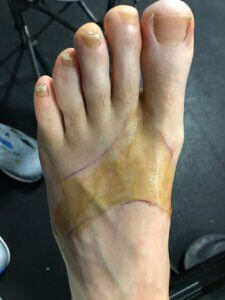
- One option is to protect the area with a strip of tape. Duct tape isn’t the best, but would work. Don’t use white athletic tape. It won’t stick. I prefer Leukotape.
- You could cut a horizontal slit in the side of the shoe over the pressure point.
- I hate moleskin and never use it. It does not stick well, does not conform to the shape of the area, and is too thick. Stick to tape. The ONLY kind I would recommend is Profoot Velvetex Moleskin (available on Amazon).
- Only wear moisture wicking socks.
Something to understand, that I preach all the time, is that what works for one person will not necessarily work for another. That goes for socks, shoes, lubricants, powders, etc. We each are an experiment of one and need to determine what our feet need. Keep me posted.
Blister Volunteers Needed
For years blister care has been fairly standard. Many athletes use Second Skin over the top of a blister and then apply tape to hold that in place. Some still use Vaseline. Others will drain the blister and cover with a Band-Aid or athletic tape. And some will use zinc oxide under tape.
All can work – but some work better than others. I’ve seen many runners who have tried one of the above with poor success.
Sometimes the lack of blister patching success happens because of a poor tape job. Maybe too little adhesive around the patch and it didn’t stick. Maybe the blister was not lanced correctly and refilled with fluid. Or maybe the Second Skin migrated under the tape and folded on itself or might have been old and too dried out to work as designed. Or the Second Skin made the skin too moist and maceration occurred, causing more problems. Or too little Vaseline or zinc oxide was used and friction reoccurred, leading to an increase in fluid.
So here’s the deal. I am interested in hearing from a few athletes, runners or adventure racers, walkers or hikers – who get serious blisters almost every time they go out. I don’t mean a minor ¼ inch blister, but a blister ½ inch or larger, anywhere on the foot. And especially those where the roof tears off, leaving raw skin underneath. The worst, the better and the bigger the better. This is not a prevention item but would be used as a treatment for formed blisters.
I have a product to test and need four to six testers.
Send me an email and tell me about yourself, what you are doing when you get blisters, and how you have treated them in the past – what you have tried and what worked or didn’t work. If will do my best to respond to all who send me an email. Please sned an email rather than a comment on the blog.
I’ll pick the best of the worst cases and supply you with sample product and suggested ways I want you to use it in the trial. I’ll give you forms to use to record your results and may ask for a photo or two. I will ask for your confidence in the trail until I can judge the results.
I make no guarantees as to whether this will work or not. But I think it’s worth a test. This is not a homegrown product but one made by a medical company.
Frostbite
Athletes who are out in cold and wet conditions need to be watchful for frostbite.
Frostbite occurs when tissue actually freezes. Toes are particularly susceptible to this serious condition. Factors that contribute to frostbite include exposure to wind, wet skin (even from sweat), and tight socks and shoes that constrict blood flow.
Early signs of frostbite include numbness, a waxy or pale discoloration of the skin, the tissue becoming firm to the touch, and pain in the area. As the frostbite progresses, the skin gets paler and the pain ceases. Often frostbite will thaw on its own as the person keeps moving or gets into a warm environment and out of the wind, wet, and cold. As the tissue warms, there can be redness, itching, and swelling.
In severe cases of frostbite, the skin becomes immobile as it freezes with underlying tissue. Blisters can form with clear or milky fluid. Blisters filled with blood indicate deeper damage. While the skin may change color, or even darken, do not assume you will lose the toes. It may take weeks or months to know if amputation is necessary. Check with your physician as soon as possible to determine what care is necessary.
Be aware of moisture inside your shoes and socks in extreme cold conditions. Sweat and outside moisture can change to ice inside your socks, leading to frostbite.
Tips for Managing Frostbite
- Do not rub your toes to warm them—that causes even more tissue damage.
- Do not rub the frostbitten area.
- Unless absolutely necessary, don’t walk on frostbitten feet or toes.
- Get into a warm environment as soon as possible.
- Immerse the affected area in lukewarm—not hot—water, or warm the affected area with the body heat from another person.
- Do not use a heating pad, heat lamp, or the heat of a stove, fireplace, or radiator for warming.
- Do not rewarm or thaw frostbite unless you are sure you can keep the area warm. It is important to remember that thawing the tissue and then allowing it to refreeze can be devastating. Get professional medical help if possible.
- Dehydration will make you more susceptible to frostbite.
One Shoe for You?
Whether you are a runner, ultrarunner, adventure racer, thru-hiker, casual walker, or something in-between, you are probably always on the lookout for the right shoe. Maybe one of the magazines you subscribe to has a shoe issue, or occasional shoe reviews. Or maybe you scour the Internet reading reviews or pay close attention to what is written in email forums to which you subscribe. It’s the elusive search for the perfect shoe.
Can there be more than one shoe that is right for your feet? Are there perfect shoes? Christopher Willett went through four pairs of shoes on his 2003 Pacific Crest Trail thru-hike (2600+ miles) and bought them as he went. Wearing size 15 running shoes, he didn’t really have the option of buying from an outfitter along the trail. He would call or use the Internet from various towns along the way and have new shoes and socks sent up trail. He started in Brooks Adrenaline GTS and liked them in the hot 563-mile Southern California section. He wished the next shoe, the Asics Eagle Trail, had a more protective sole but liked the tread. While the New Balance 806s were structurally good, he felt they had a poor tread design and they are the only shoe that he would not wear again. He finished the last 670 miles in the Asics Gel Trabuco V and liked their durability and tread. Would one of the shoes have worked for his whole thru-hike? If they had been the NB 806s, the answer would be no. Probably any of the other three would have worked the whole way, but Chris might have had problems sticking with one shoe given the varying weather and terrain of the trail. Even the most perfect shoe can have small issues: breathability, tread design, cushioning, sole protection, and so on. Each of these issues can make them perfect for one set of conditions and wrong for another.
In reality, there is more than one shoe that is right for your feet. What’s important, regardless of which shoe you choose, is that the shoe fits.
Note: The photo shows part of the display of shoes at Zombierunner, Palo Alto. They have a great store.
13 Christmas Gifts for Your Feet
Filed under: Foot Care, Foot Care Products, Footwear Products
What better time of the year to pamper your feet than Christmas. Our feet are encased in heavy socks and footwear. We take them for granted. Here’s a look at my favorite things for your feet this year. My suggestion is to check out these items at Zombierunner.com. Don and Gillian support athletes with great service. You can click on their link and at their website, click on Foot Care or any other items. Zombierunner has everyone of these items, except a callus file.
Engo Footwear Patches – these slick patches go in your shoes to reduce friction. A must for any foot care first aid kit.
Drymax Socks – my favorite socks that hate moisture. Their micro-fiber technology is a sweat removal system to keep your feet dry.
Injinji Socks – the original toesocks that are perfect for many sports, and a must for those who are prone to toe blisters.
Sportslick Lubricant - Prevents blisters, chafing and skin rash during sporting activities. This skin care product also cures jock itch, athlete’s foot, and other skin conditions.
Stuffitts Portable Drying Solutions – for shoes, gloves, helmets to defeat wet and stinky gear. Their soft, lightweight forms combat moisture and kills odor in personal wearable gear.
BlisterShield Powder – a great powder, especially for those who prefer powder over a lubricant.
Kinesio Tex Tape – a great tape that breathes and conforms to the shape of any part of your feet. 1, 2, and 3 inch widths.
Leukotape – one of the stickiest tapes available. 1 ½ inches wide.
Superfeet Insoles – one of the best insoles for support. They are available in a number of options.
Toenail Clippers – everyone needs a good clipper to tame their toenails.
Callus File – a callus build-up can lead to problems that can result in blisters underneath this hard layer of skin.
Natural Running – this is a great book that teaches you to run the way nature intended, mimicking the healthy, efficient barefoot style you were born with, while keeping feet safe from rough modern surfaces.
Fixing Your Feet, 5th edition – my best-selling book that covers all aspects of footwear and foot care.
Here’s the Amazon link for the Fixing Your Feet print edition.
Here’s the Amazon link for a Fixing Your Feet Kindle edition.
I hope you’ll consider one or more of these as gifts either to yourself or a friend.
Disclaimer: I am an affiliate of Zombierunner and make a few pennies when you buy through my link.
A Great Vibram FiveFingers Review
Filed under: blister care, Foot Care, Footwear, Sports, Travel
Last week I read a report over at BirthdayShoes.com about a guy who completed the Jungle Marathon in the Amazon in Vibram FiveFingers. I was fascinated by what I read and contacted the race director who made the connection. Stuart Crispin sent me the article he submitted to Vibram.
“I recently completed the 2012 Jungle Marathon in Brazil, and in doing became the first person ever to take part in and finish this grueling event wearing a pair of Vibram FiveFingers (VFFs). With the help of a pair of VFF Spyridons men’s 43 I even managed to finish the worlds toughest endurance race, as listed by CNN, in 5th place overall. I did not wear toe socks at any time during the race. [Stuart's overall time was 47 hours, 43 minutes.]
The race is a six-stage, seven-day self-supported foot race. Runners have to carry all of their food, clothing, hammock, sleeping bag/liner, medical kit and other mandatory kit, as well as 2.5 litres of water (picked up at every checkpoint). My rucksack at the start of day one weighed about 12.5kg. The longest stage on day five is a non-stop 108.5 km ultramarathon. The total seven-day distance covered was over 255km across swamps, dense jungle, mangroves, sandy beach, creeks, rivers and dirt roads. (Details at junglemarathon.com).
Before flying out to take part, I wrote to the race director who advised me not to wear VFFs suggesting they might not offer enough support for such a long distance race. I also emailed a previous competitor, who is also a physiotherapist for her advice on wearing VFF. Her response was ‘… FiveFingers will be a disaster… they will not offer your feet the support they need… they are not designed for such long distance running… and they won’t have enough grip to help you stay upright on the seriously wet and muddy terrain, particularly on the severe ascents and descents.’
Despite this advice I opted to go with my Spyridons. Thanks to the clever Kevlar lining in the sole I had every confidence they would give my feet enough support to avoid injury to the sole of my foot while running through the dense jungle, where the floor was covered in sharp spiky objects as well as spiky stinging insects like scorpions. I felt no impact at all underfoot and the Spyridons’ grip was more than adequate to cope with the muddy terrain. A week before going to Brazil for the race I wore my Spyridons to hike up Snowdon, the UK’s third highest mountain. They were great for that too, although while walking across large, wet slightly tilted rocks and boulders I could feel my feet slip slightly, but I think that may have happened in walking boots also. The hike up to the summit left me in no doubt that my Spyridons were the right choice for the Jungle Marathon.
The tough material used for the upper is still in exactly the same condition it was before the 255km race. There are no tears or cuts at all to the upper of both shoes, and the soles too are also damage free. The only minor sign of wear and tear is a very small section of the material on the outside of one of the big toe pockets, where it has very slightly come away from the sole. But in order to see it you have to look closely and after such a long way in some seriously aggressive and tough terrain, including deep bogs and swamps I think that is extremely impressive and shows how robust the Spyridons are.
I did have a concern about using the Velcro strap version as I wondered how it would hold up in the swamps and bogs. Some of the bogs were up to 1km long and over knee deep with mud. My concern was whether the strap would stay secure and tight when pulling my leg up out of the mud, as I did not fancy losing a shoe. However, the VFFs are designed to fit snugly to the foot so although on a couple of occasions the strap came undone the shoe remained firmly in place on my feet. But this did not happen during every swamp or bog, and there were many.
Every single day of the race I had several other competitors asking me about my choice of footwear, often questioning whether I would be able to finish the race. My reply was the same every day, that they were extremely comfortable and I felt no pain or any objects under foot at all. They looked amazed but also looked very impressed. Many of them said they were going to try using VFFs after the event. Perhaps even more impressive than the toughness of the shoe, is the comfortableness of the Spyridons for running and hiking. After running 255km I did not have a single blister on either of my feet, and that is dispite starting and finishing every day with wet soggy feet. The only sores I had on my feet were between a couple of my toes caused by sand getting between them during the 108.5km long stage. I had already run several miles on sand during the previous four stages without any problems with the sand at all. During the long stage I think it only happened due to having had wet feet since 4.30am at the very start of the stage when we started with a river crossing, and by the time I ran on sand I had been running with wet feet in 35 degree heat in almost 100% humidity for over 12 hours. Perhaps if I had put on a pair of toe socks I may have been able to prevent the sores at all but as they were only minor I opted to just carry on to the finish.
The race director, who advised against wearing VFF, saw me on day four at the first checkpoint and said she couldn’t believe I was still going wearing them, and going so well. She said every day she expected me to pull out with trashed feet and after the race told me how seriously impressed she was with me for finishing in 5th place and wearing VFFs for the entire race.
I had reservations myself about wearing VFFs and I don’t think my Bikilas, KSO’s or Classics FiveFingers would have been up to the task. But thanks to the Spyridons trail running qualities I was able to wear them. In my opinion the Spyridons are the most comfortable running shoe I have ever worn. I have run over 20 marathons on both road and off road, and several ultramarathons including multi-day events in the Sahara, the Atacama in Chile, the Himalayas and Scottish highlands, as well as 100km and 100 mile non-stop races. I have worn several different brands of running shoes, some of which have left me with horrendous blisters. Some have been ok when it comes to blisters, but even if I finished blister free I always felt ‘hot spots’ which is the start of a blister. I have never worn a running shoe that has left me with zero blisters and zero hotspots.
I would have no hesitation at all in recommending VFF to other runners and for trail/off road running at the moment in my mind there is no better option than the Spyridons.
I will definitely be using Spyridons for my future off road running and will continue to recommend them to other runners who always approach me at races and while I’m out training, asking about them and how they feel.
I would be happy for you to use this review if you wish, as I would like other people to know about my experience of using VFFs. I searched the web before the race looking for other reviews or advice on using VFFs in such extreme environments but the information out there was limited. No one has ever worn Fivefingers in such an event and I would be happy to share my experiences with others. I am also a qualified personal trainer, as well as a London based firefighter, and will recommend the sensible and safe use of VFFs to some of my clients where suitable.
Stuart Crispin
London
I asked Stuart a few questions and here is what he wrote back, “The Jungle Marathon was my first multi-day race wearing Vibrams. Before that I ran the London Marathon in VFF Bakilas but since I hadn’t run further than 12 miles in them before the marathon the jump in distance was rather silly and I did get some minor pain in my left foot. But I didn’t get a single blister or hot spot and like in the jungle I ran with no socks. My longest run before the Jungle was 14 miles off road and I ran with wet feet and again had no blisters. I have run several multi-stage ultras and marathons and only the VFFs left me with no blisters. I know they probably won’t work for everyone but I won’t run in trainers ever again. Before wearing VFFs I used Injinji toe socks and they definitely helped reduce the amount and severity of blisters I got from running than when I wore normal socks (including two socks).”
Thank you Stuart for this great report and congratulations on your finish.
If you are interested in learning more about the Jungle Marathons, the links are below. Shirley Thompson, the race director, puts on challenging races, well run with a great safety record, and a professional staff. It is my hope to be at both these events next year.
The Jungle Marathon – Amazon (2013 October)
The Jungle Marathon – Vietnam (2013 June)
In October 2010 I wrote a blog post about a runner at the six-day ThanksRockies who wore FiveFingers for the 115 mile race. If you want to check out the link, here’s the post: Vibram FiveFingers at the Gore-Tex TransRockies.
More on Prevention
Last week I wrote about prevention and being proactive. I emphasized that you are the key to prevention. I want to share an email I received from a friend that is a great example of this in action. Lisa told me about her friend and gave me permission to share the story:
My friend ran a 50km x 2 (100km total, over two days) race a few weeks ago. Over the past six months he has put a lot of work into his running training and has been running beautifully.
I was away so when I got back I dropped him a text to see how his race went. He told me what happened and in the conversation said that he would be losing many of his toenails. I ask why and he said he forgot to cut his toenails.
As you can imagine I didn’t reply to this at all because I would have thrown some insulting words his way.
He has been trail running for more than a decade and been doing adventure racing for over a decade. He spent a fairly sizable amount on his race entry and it must be about 900km to travel to the race. He put in six months of training to get stronger and faster. And he forgot to trim his toenails! This is more than elementary and is totally stupid. It’s tough to have sympathy (I have none!) when friends do silly things like this. He knows better.
Lisa de Speville, Johannesburg, South Africa
Lisa’s Adventure Racing website
FEAT: Fascinating Adventure Racing Talks
Lisa’s Blog
This story speaks for itself. I have often talked about how athletes spend a lot of time and money in preparation for an event but fail to plan for good foot care. More times than I care to remember, I have seen athletes quit a race or be pulled from a race because of feet gone bad. It doesn’t have to be that way.
I’ll say it again, you are the key to prevention.
Foot Care and Prevention
Filed under: blister care, Foot Care, Footwear, Health, Sports, toenails
I believe strongly in prevention as a proactive measure in foot care.
Tim Noakes’ sixth law of running injuries must be heeded—any running injury can be cured only after the cause is found and eliminated. All of us who run, hike, or adventure race at some point have problems with our feet or sustain foot injuries. The prevention chapters are numerous and lengthy because many factors contribute to foot problems and injuries, and for every factor, there is a preventive measure that can reduce or eliminate it. Prevention is the key to saving your feet. Dave Scott, a good friend and ultrarunner, put the foot problem in proper perspective: “When you don’t take care of your feet during a long run or race, each step becomes a reminder of your ignorance.”
It’s very easy to relinquish our responsibility for preparedness and let someone else dictate what we should do. We tend to listen to those whom we look up to and to those who are more experienced. In many ways this is OK, and it is often the way it should be. However, only you can determine what works for your feet.
Knowing your prevention options is important. That’s being proactive. I get emails every week from athletes who are looking for answers for their feet issues.
Some have my book but others don’t. Some have the book and have gone through the chapters to find possible treatment options. Others have the book and haven’t read it – and want me to answer their questions.
I try. Sometimes it works and sometimes not. While I answer from my experience and knowledge, I don’t have your feet. And that’s important.
Your feet have your abnormalities (hammer toes, bunions, thick toenails, skin that calluses, a tendency to athlete’s foot, a tendency to blisters, etc.), your ankles, your shoes and socks, your fit (good or bad), your training base, your stride and gait, and more.
You are the best person to find what works for your feet. Others may give suggestions. Fixing Your Feet can give suggestions and I may offer a few via email or in this blog, but you need to try them on your feet to find the one that works best.
You are the key to prevention.
Please, don’t show up at a race with a bad case of athlete’s foot, holes in your socks, shoes that have outlived their support, insoles that are flat as paper, toenails that are long and untrimmed, shoes that don’t fit, huge thick calluses, blisters that are unhealed, thick nails from untreated toenail fungus.
Yes, I have seen all of these.
Again, you are the key to prevention.
Fit and Inserts
In choosing footwear, fit is everything. You may buy a new pair of shoes, not get a good fit, and use them for short runs or races without much problem. But the longer you’ll be wearing them at a time, the more important the fit.
Here’s a trick to help get ensure a good fit.
Rich Schick, a physician’s assistant and ultrarunner, shared that he believes the key to getting the proper size shoe is the insert – often called insoles. “If the foot does not fit the insert, then the shoe will have to stretch to accommodate the difference or there may be excessive room in the shoe, which can lead to blisters and other foot problems.” He thinks there is too much confusion about straight lasts, curved lasts, semicurved lasts, and so on.
Rick suggests, and I agree, that you don’t need to know any of this if you use the insert to fit your shoes. The same holds true for the proper width of shoe. Simply remove the insert from the shoe and place your heel in the depression made for the heel (in the insert). There should be an inch to an inch and a half from the tip of your longest toe to the tip of the insert. None of your toes or any part of the foot should lap over the sides of the insert. If they do, is it because the insert is too narrow or is it because of a curved foot and straight insert or vice versa? The foot should not be more than about a quarter inch from the edges of the insert either. This includes the area around the heel, or the shoe may be too loose. Check to see if the arch of the insert fits in the arch of your foot. Finally, if all the above criteria are met, then try on the shoe. The only remaining pitfalls are tight toeboxes and seams or uppers that rub.
Remember to take into a account the type and thickness of socks you’ll be wearing. If you are going to replace the stock inserts that come with the shoes, make sure to follow this tip.